
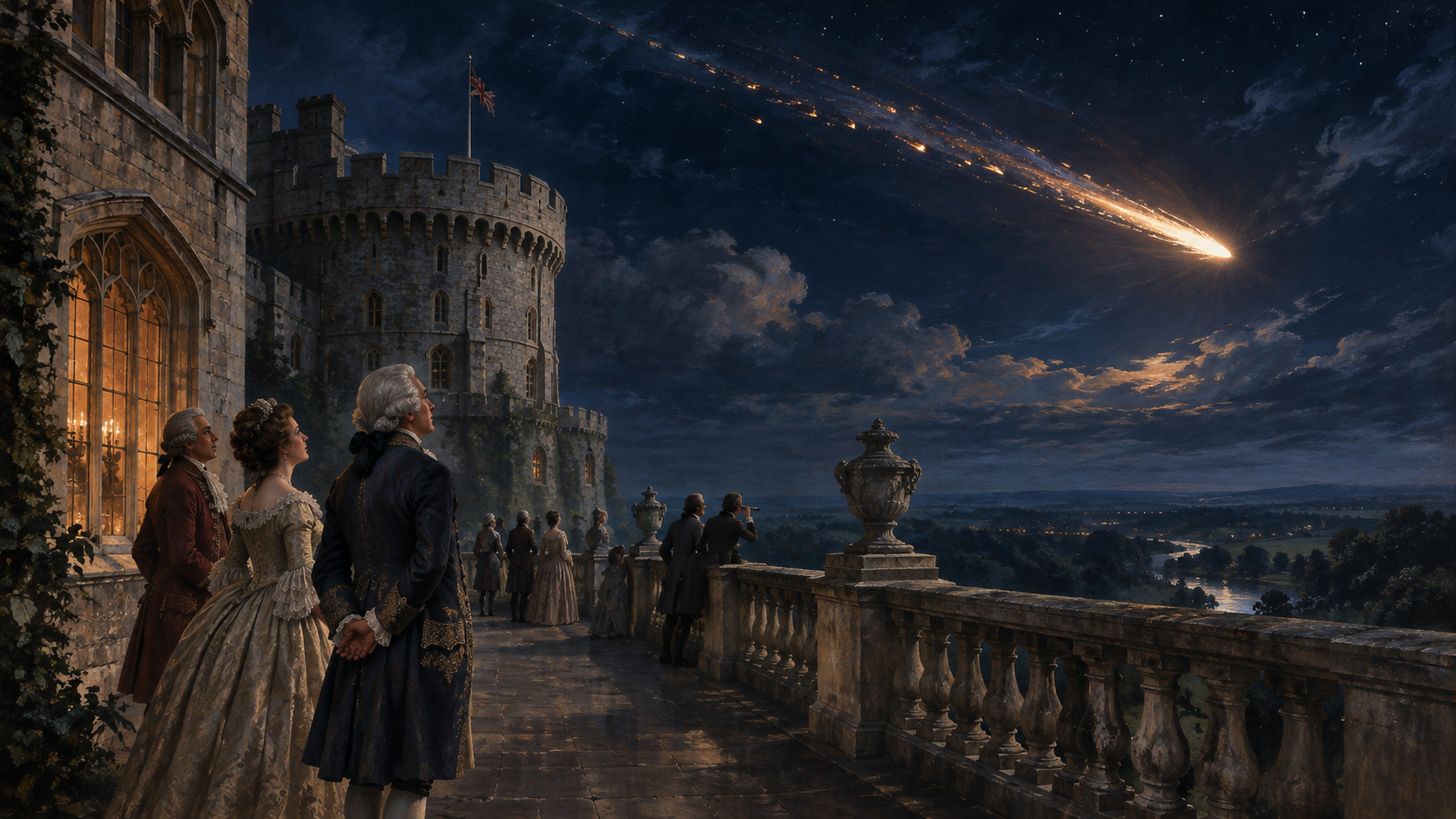
A dramatic sky with a documented natural subject
An old picture of a brilliant object crossing the sky can easily enter a UFO collection with its original label missing. Windsor’s 1783 meteor offers a useful counterexample: spectacular imagery and a scientific investigation belong to the same historical record. Mystery does not require every unusual light to remain unidentified.
The Royal Society preserves material for Tiberius Cavallo’s account of the meteor observed on 18 August 1783, published in Philosophical Transactions in 1784. The catalogue entry has an inconsistent date in its heading, but its publication details identify the paper as concerning 18 August. For this article, that published observation date takes precedence over the conflicting catalogue title. [1]
Follow the art and the observations separately
The Royal Collection catalogues Paul Sandby’s depiction of the meteor seen from the north terrace at Windsor. It gives the scene an identifiable artistic history rather than leaving it as an anonymous image of a supposed craft. The Royal Society also discusses Alexander Aubert’s observations of the 1783 meteor, showing how another observer tried to record its appearance. [2][3]
Our assessment: the artwork and the scientific accounts should be compared without expecting them to perform the same job. A painter can organize a dramatic view; an observer can attempt estimates; a later catalogue can contain a clerical inconsistency. Finding that inconsistency is a reason to inspect the publication, not evidence that the event itself was concealed.
Why include it in an alien-history series?
This case provides a reference point for reading less well documented sky stories. Before inferring technology from a streak, glow or fragmentation, ask whether the source already identifies a natural event and whether that identification survived later retellings. Windsor has no demonstrated connection to Tartary or alien contact. Its value here is methodological: an extraordinary sky can leave beautiful images, multiple records and an entirely terrestrial history of investigation.