
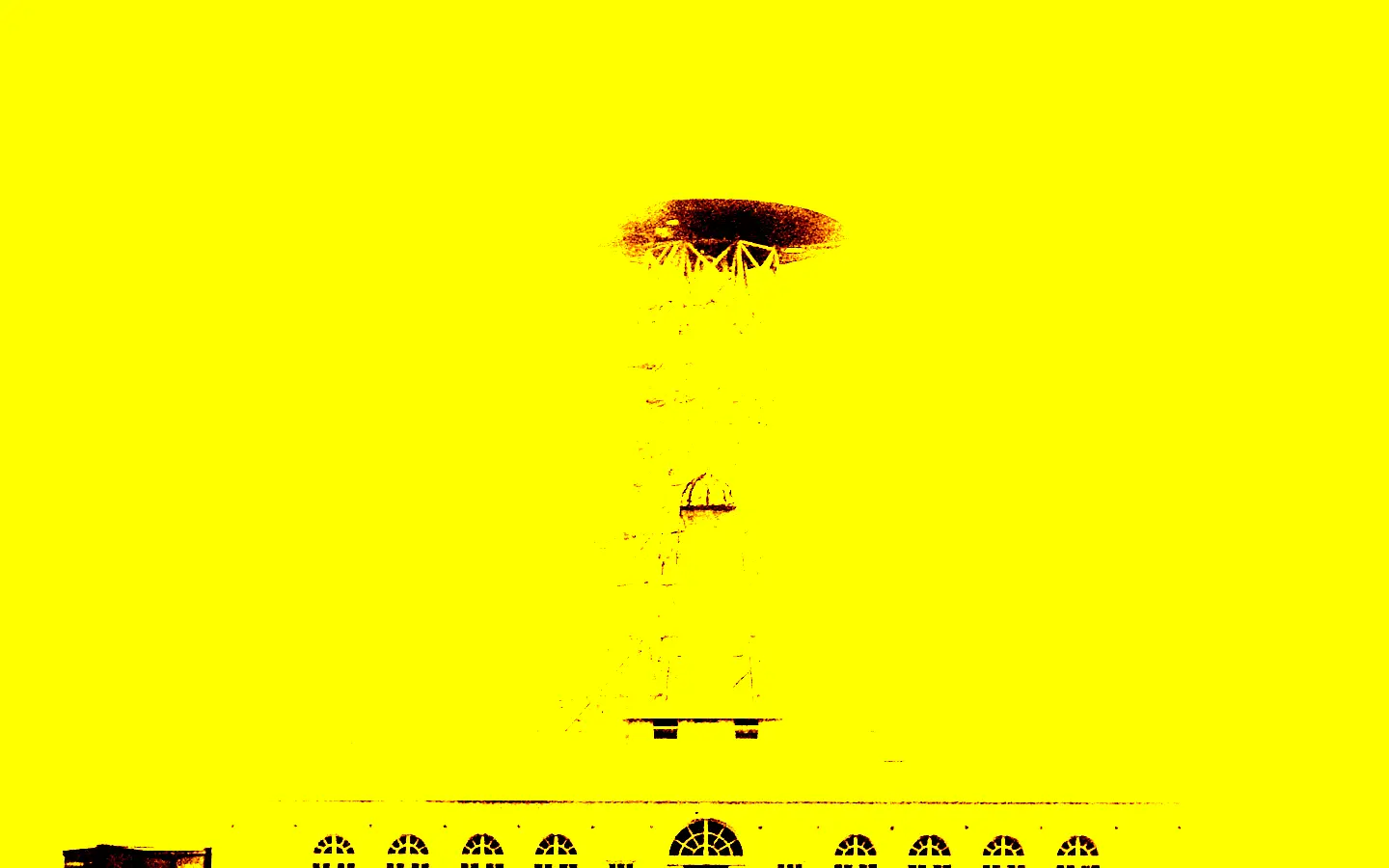
Across social feeds, collections of old civic buildings are arranged like components on a circuit board: copper domes as capacitors, pointed finials as antennas, and underground foundations as conductors. Remove the dates and street names, and the repeated shapes can look uncannily technological.
The strongest version of the claim proposes an atmospheric energy network. Towers drew electrical charge from the air, domes stored or tuned it, and ironwork carried power through buildings without fuel or wires. Some versions add a non-human source: an earlier civilization received the system from extraterrestrial engineers, then disappeared in a catastrophe or deliberate historical reset.
No verified device has been recovered
There is no publicly authenticated machine, engineering drawing, measured output, or archaeological context demonstrating that historic domes supplied usable wireless power. Visual resemblance starts the question; it does not complete the circuit.
What domes and finials actually did
Domes solve architectural problems elegantly. Their curved form spans large interior spaces while distributing weight into supporting walls or columns. Churches, capitols, railway stations, and exhibition halls used them to create spectacle and recognizable skylines.
The metal details have ordinary jobs too. Finials finish a roofline, flagpoles announce a civic identity, and lightning rods provide a low-resistance path toward ground. Copper became common on roofs because it can be shaped, resists corrosion, and develops the green patina now associated with “Tartarian” imagery.
Metal spires, domes, grounding systems, and repeating ornament appear on many historic buildings.
That these parts operated together as generators or delivered useful power to occupants.
A lightning rod can handle a dramatic electrical event, but that is not the same as harvesting steady, controllable energy. A conductor, capacitor-like shape, and electrical potential do not automatically form a practical power station; a working system also needs conversion, regulation, distribution, insulation, and a load.
Why Nikola Tesla enters the file
Tesla’s experiments make the theory feel less impossible. He demonstrated wireless lighting, investigated high-frequency currents, and built Wardenclyffe Tower while pursuing long-distance communication and power concepts. Photographs of coils throwing artificial lightning supply the perfect visual bridge between Gilded Age architecture and lost technology.
But Tesla’s work is documented as experimental engineering, not evidence of a suppressed global network inherited from Tartaria. Wardenclyffe required machinery, financing, generators, and purpose-built apparatus. Its story shows that wireless-power ideas were actively explored—not that every cupola was secretly using them.
Where the alien-tech theory begins
The extraterrestrial version usually rests on scale and repetition: if similar forms appear across continents, perhaps a single advanced teacher spread them. Yet architectural motifs also travel through pattern books, trained architects, empires, religious traditions, industrial manufacturing, and competition between cities.
For an alien origin to become the best explanation, the file needs something only that explanation predicts: materials with anomalous manufacture, components beyond the period’s capability, independent records of contact, or a reproducible machine whose operation cannot be explained by known engineering. At present, those pieces are missing.
Ask what evidence would distinguish the theories
If the same ornament is expected under both “fashionable architecture” and “alien energy grid,” it cannot decide between them. Search for wiring routes, insulators, service spaces, output measurements, maintenance records, and physical components instead.
Archive verdict
The buildings are real; the alien power network is not established. The theory succeeds as a way of making familiar architecture strange again. It encourages people to notice rooftop engineering, forgotten infrastructure, and the optimism of an age obsessed with electricity.
The evidence currently favors conventional architecture, lightning protection, decoration, and documented electrical experiments. The most productive mystery is not who erased a planetary generator, but how quickly urban technology becomes invisible once its original purpose is forgotten.