
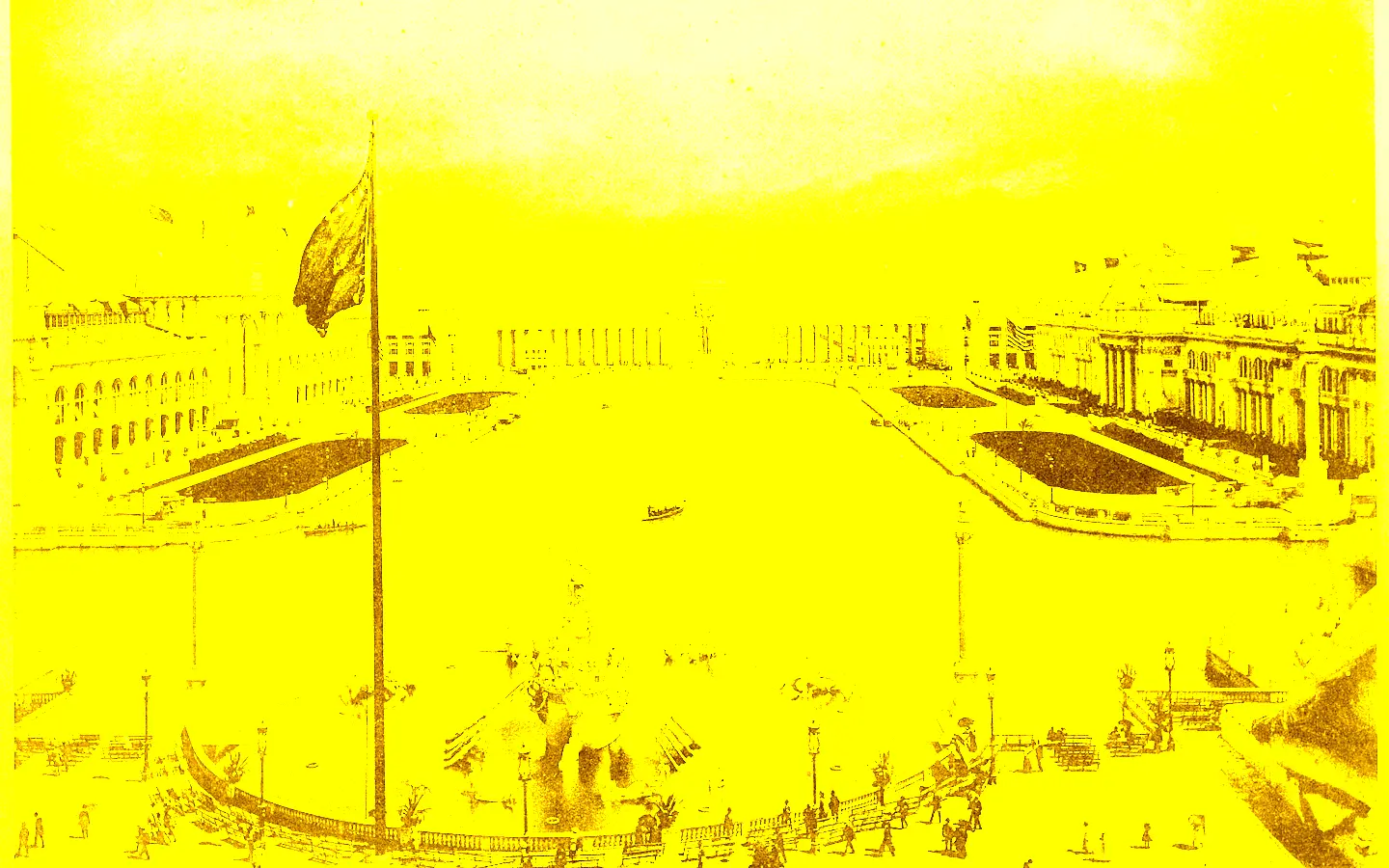
The photographs feel like evidence from the wrong timeline. Vast colonnades frame lagoons; domes multiply across a luminous horizon; statues and triumphal arches seem to have arrived fully formed. At night, thousands of electric lamps turn the grounds into a vision of a future that somehow looks ancient.
To Tartaria theorists, fairs such as Chicago’s 1893 World’s Columbian Exposition raise a blunt question: how could builders create so much, so quickly, only to demolish it? One answer says they did not. The organizers allegedly occupied surviving structures of a lost civilization, renamed them exhibition halls, and destroyed them after the public had seen too much.
The photographs compress years of labor into a single moment
Finished views hide surveyors, workshops, rail deliveries, scaffolding, crews, cost overruns, repairs, and unfinished backsides. What survives visually is the impossible city—not the industrial process that assembled it.
The secret was in the surface
Many fair buildings were enormous, but “monumental” did not mean permanent. Designers used structural frames faced with a temporary material often called staff: a mixture associated with plaster, fibers, and other ingredients that could be modeled rapidly into columns, reliefs, and statues.
That construction method produced theatrical scale without the time and expense of carving entire facades from stone. It also produced buildings vulnerable to weather, fire, and decay. Photographs show convincing classical architecture because convincing appearance was the assignment.
Build a spectacular envelope quickly, open on a fixed date, and prioritize appearance over a century-long service life.
Black-and-white photographs can make staff, wood, and painted surfaces read as solid marble and masonry.
Why create a city just to destroy it?
World’s Fairs were temporary events with temporary economics. Their sites had leases, operating budgets, planned closures, and future land uses. Once ticket sales ended, maintaining acres of ornate exhibition halls became a liability. Salvage had value; empty fantasy palaces did not.
Fire also shaped what disappeared. Lightweight construction, extensive electrical installations, kitchens, crowds, and incomplete fireproofing created risk. Some structures burned during or after fairs; others were dismantled. A small number survived because communities found money and purpose for them.
Demolition can feel like evidence of concealment because destruction removes the object that might settle the debate. But planned impermanence predicts demolition too, and it also predicts the construction contracts, progress photographs, material descriptions, workforce accounts, and site plans found around major expositions.
The alien infrastructure layer
In the most expansive version, the white cities were not merely Tartarian. Their axial layouts, domes, lagoons, and electric illumination formed energy or communication complexes inherited from non-human visitors. Human fair organizers supposedly disguised the sites as entertainment before dismantling the machines.
The difficulty is specificity. Grand symmetry can express power. Lagoons can manage landscapes and spectacle. Towers can act as landmarks. Electric lamps can demonstrate a new commercial technology. None of those functions requires an alien system, and no verified extraterrestrial component has emerged from fairground archaeology.
A cover-up should leave a different debris field
If demolition concealed advanced machinery, records or excavations should reveal anomalous alloys, unexplained conduits, specialized foundations, restricted recovery operations, or components inconsistent with exhibition use. The known material story instead matches temporary architecture and ordinary infrastructure.
Archive verdict
The lost city feeling is authentic; the inherited alien city claim is unsupported. World’s Fairs were designed to overwhelm visitors and photographs still perform that job. Their speed came from industrial organization, temporary materials, huge labor forces, and a deadline—not from finding completed palaces.
The deeper story remains extraordinary. Cities built full-scale dreams, switched on electric futures, welcomed millions, and then accepted their disappearance. The ruins are not proof of erased aliens. They are evidence that modern societies can manufacture wonder—and discard it—with startling speed.