
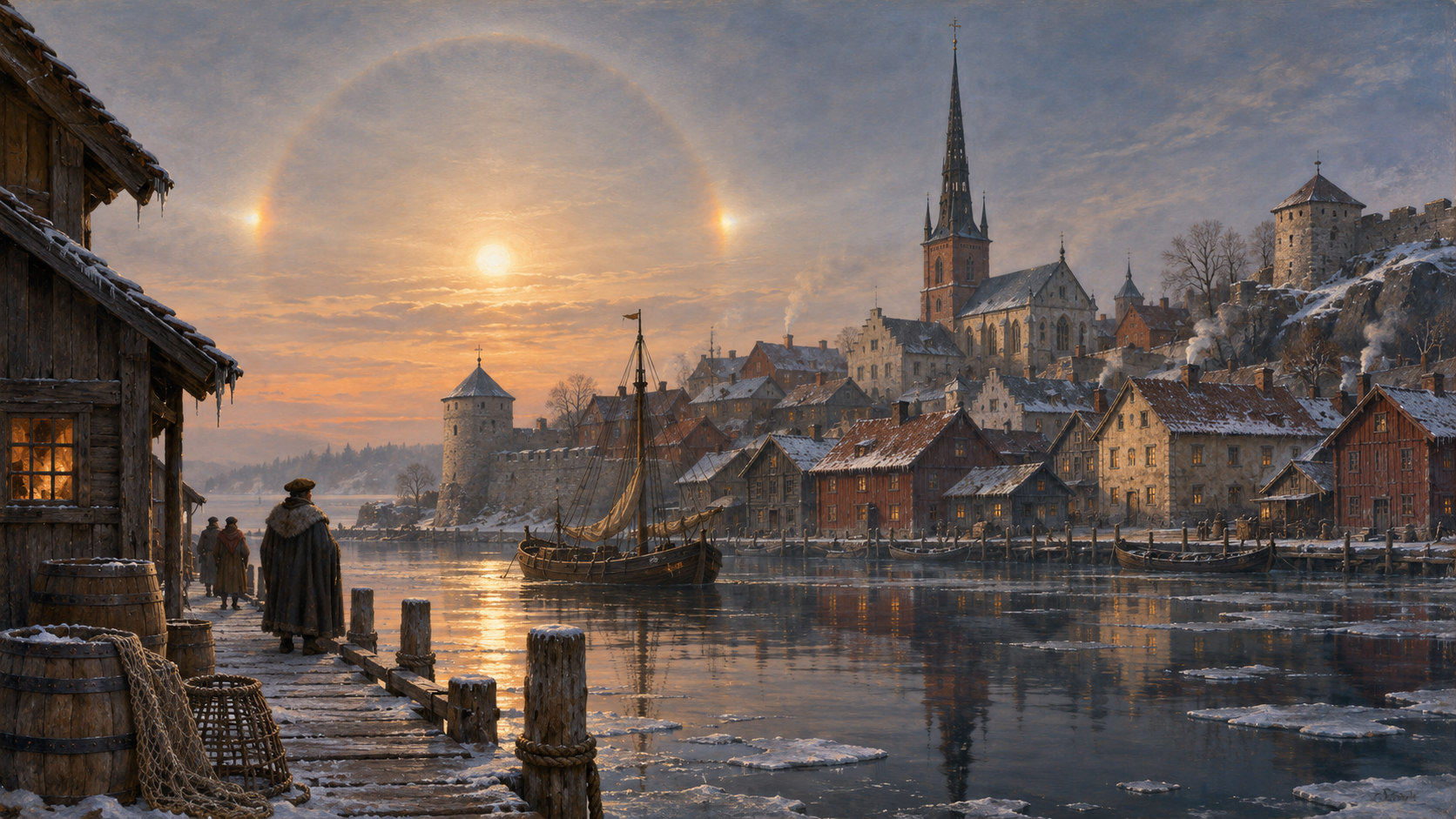
A sky that looks impossible
Bright rings above an old city can look startlingly modern to a viewer expecting flying saucers. Stockholm’s Vädersolstavlan invites exactly that reaction. Yet the first step is to identify the artwork, rather than treating each painted circle as an independently observed machine.
Stockholm’s municipal history archive describes the scene as a view of the city associated with 1535. Technical examination during conservation in 1998–99 established that the painting now hanging in Storkyrkan is a copy from 1636, made by Jacob Elbfas. The original is usually attributed to Urban Målare. That distinction places a century between the represented scene and the surviving painted object. [1]
The atmosphere can build strange geometry
Sun dogs are bright patches produced when sunlight is refracted through ice crystals. Solar halos can also form through the interaction of light with ice crystals in high clouds. The Royal Meteorological Society explains how crystal shape and orientation create circles, arcs and false suns. A display can look engineered even when the mechanism is atmospheric. [2]
This physical context gives readers a sensible way to approach the painting’s title and imagery. It does not turn an artistic composition into an exact optical measurement. We should avoid using the position of every painted ring to calculate a flight path, just as we should avoid assuming that every visible building was drawn to survey accuracy.
An archive mystery, without an invented empire
Our assessment: the painting is valuable evidence about an image, its transmission and the city it portrays. It does not establish a fleet of alien craft. A useful comparison asks how artists represented an exceptional sky and how subsequent viewers changed its meaning. Stockholm also lies outside the Asian regions European maps called Tartary. Its place in this series is chronological and thematic, not evidence that a Tartarian state controlled Sweden.