
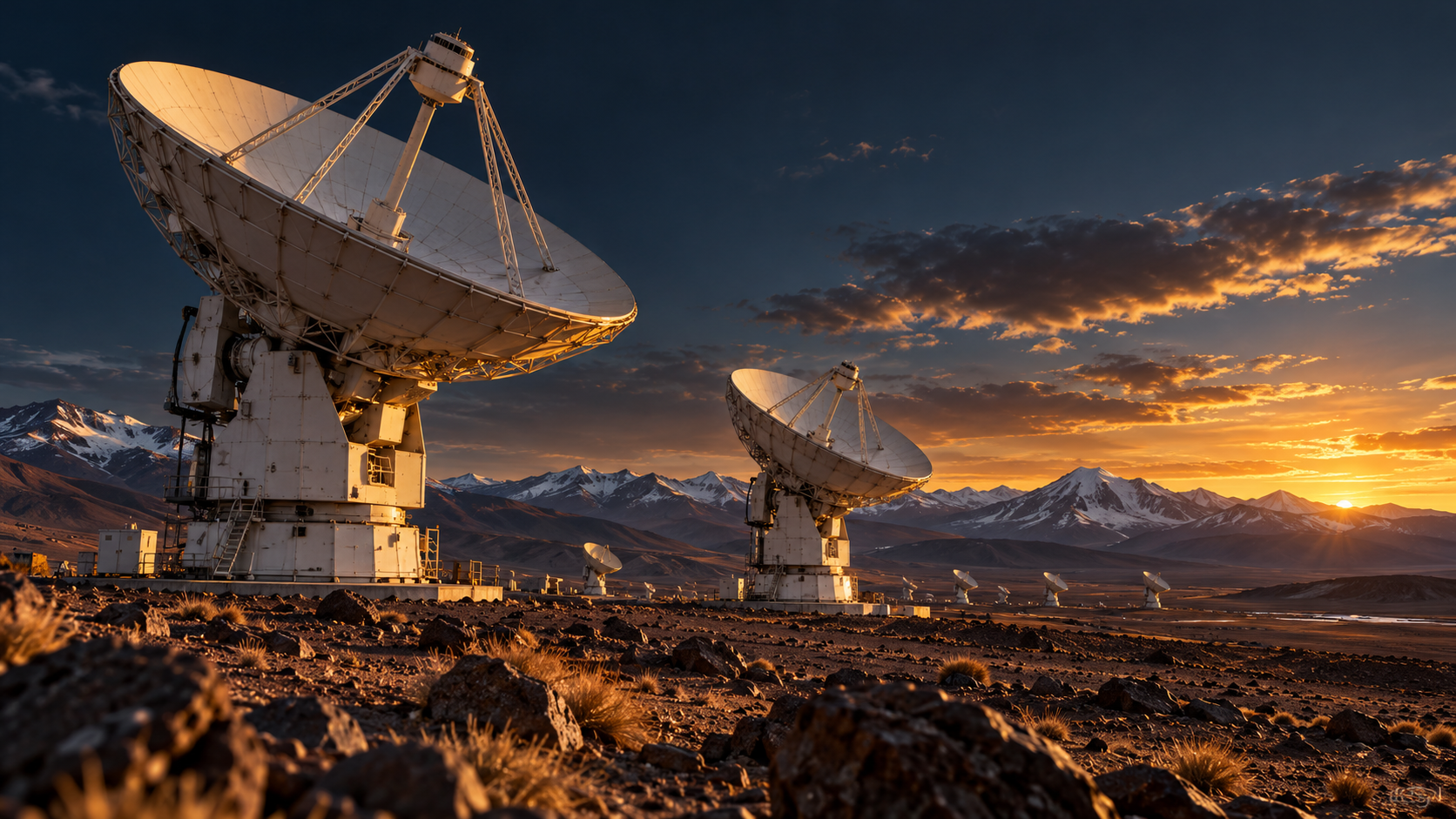
A search has a frequency as well as a direction
When a listening experiment reports no artificial signal, the conclusion belongs to the observation that was actually made. It cannot automatically describe every wavelength or every way a technology might leave a trace.
A proposal submitted on October 15 by Louisa Mason and colleagues examines that limitation through millimetre and submillimetre SETI. The authors outline ways an ALMA2040 capability could explore territory beyond the familiar centimetre-wavelength emphasis. This is a program of suggested tests, not an announcement that extraterrestrial hardware has been found. [1]
What the proposal adds
The paper describes several possible approaches, including narrowband searches, aggregate technological leakage, cold waste heat associated with computation and geometric signatures of hypothetical structures. It also discusses the observing requirements needed to pursue them. [1]
These possibilities should remain possibilities in the language of the archive. Naming a signature is not evidence that a civilization produces it, and outlining an instrument requirement is not proof that the requested observation has already been performed.
The intriguing question of waste heat
The waste-heat idea changes the question from whether somebody intends to communicate to whether a technological activity might leave a detectable by-product. The proposal includes this as one speculative avenue within a much broader search design. [1]
That difference is worth keeping visible. A deliberate beacon and an unintended emission would require different expectations about where to look, what to measure and how to interpret an unfamiliar feature. Neither expectation should substitute for identifying a source.
How to read a capability forecast
A projected observing horizon or sensitivity depends on the assumptions used to calculate it. For a reader, a useful test is to ask what source was imagined, what instrument was assumed and how much observing time was allocated.
Those are questions for assessing the proposal, not deficiencies this article has independently established. They help prevent a conditional engineering forecast from becoming a statement that an instrument can already detect any civilization within a fixed distance.
A wider search, with a precise status
This story is distinct from a new signal candidate or another review of a well-known object. Its subject is the design of a search window: which physical traces might be accessible if observers explore a less studied part of the spectrum.
The next milestone would be implementation and a result tied to an actual dataset. Until then, ALMA2040 belongs in the archive as a research proposal with explicit requirements. The possibility is compelling because it can guide measurements, not because it lets us fill an unobserved part of the sky with imagined machines.