
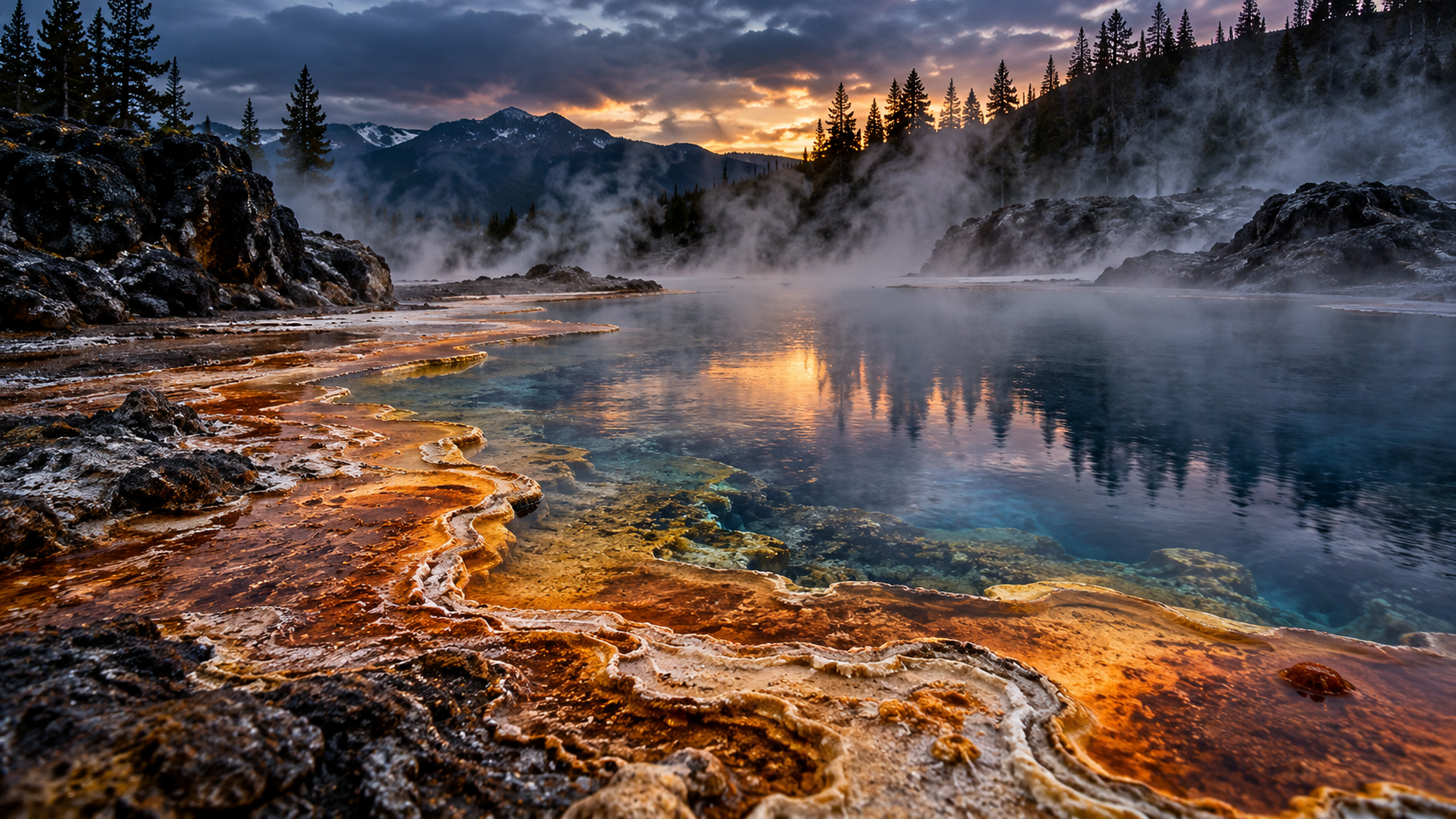
A boundary measured in a hot spring
One way to search intelligently for unfamiliar life is to first discover where familiar life can survive. A laboratory result from an earthly organism can test a boundary that otherwise becomes an assumption in the discussion of distant worlds.
NASA reported on September 22 that researchers studying the amoeba Incendiamoeba cascadensis found it could reproduce at 63°C. The organism came from heated waters in Lassen Volcanic National Park. NASA describes the result as a record for known eukaryotes, organisms whose cells contain a nucleus and other internal machinery. [1]
Complex cells do not necessarily mean many cells
The nickname fire amoeba is memorable, but its significance is cellular complexity, not the discovery of a miniature animal. Eukaryotes include single-celled organisms as well as multicellular ones. The amoeba should not be described as proof that animals can flourish at the same temperature. [1]
This distinction matters for the language of habitability. A statement about the endurance of one cell type cannot simply be promoted into a statement about an entire ecosystem.
Survival is not the same as reproduction
NASA distinguishes the amoeba’s ability to divide at 63°C from activity at somewhat higher temperatures and recovery after brief hotter exposure. Those are different biological achievements, not interchangeable records. [1]
For an investigation, the distinction suggests a better question than how hot life can get: which functions can an organism sustain, for how long, and under what surrounding conditions? A short successful exposure would not establish a permanent habitat.
What changes for other worlds?
NASA’s account emphasizes that temperature is only part of the environment. Water, acidity, oxygen, pressure and food also matter. The amoeba’s success therefore widens one measured tolerance without making a distant planet automatically suitable for it. [1]
The astrobiological lesson is to examine constraints individually and then together. If one limit moves, the rest of the requirements do not disappear. An environment must still support the processes an organism needs to continue living.
An earthly result with a wider question
No alien organism was found in this study. The result is valuable because it replaces a presumed boundary with something that can be tested and compared. It encourages a closer look at environments that may have been dismissed too quickly.
For the archive, the finding is a reminder that the limits of our observations and the limits of biology are not always the same. The search for unfamiliar life improves when researchers keep checking which boundaries are real and which reflect an incomplete sample of Earth.