
The location is part of the experiment
A spacecraft cannot sample a whole world at once. Choosing where to investigate is already a scientific argument: it determines which histories a measurement might preserve and which processes could have produced the material under examination.
A review published online in Astrobiology on October 7 examines Selk crater on Titan in preparation for NASA’s Dragonfly mission. The authors focus on the crater’s formation, subsequent evolution and the chemical products that might remain in its impact-melt deposits. [1]
Why an impact deposit is interesting
The review considers the composition of the crust, material contributed by the impactor and the duration of chemistry involving liquid water in the melt deposits. Its aim is to constrain the reactions that could have taken place and guide the interpretation of future measurements. [1]
That is a more specific task than declaring a whole moon habitable. It asks whether a particular geological setting created a particular chemical opportunity, and whether traces of that opportunity might still be recognizable.
From chemistry to a sampling plan
The authors also discuss where reaction products might best be sampled and how Dragonfly could identify and characterize them. This makes the review a bridge between an environmental reconstruction and a practical observing strategy. [1]
In a case-file analogy, a chemical finding would be a clue whose location matters. Material from one deposit may record a different sequence of processes from material nearby. Separating those histories can be as important as identifying the molecule itself.
What Dragonfly is being asked to investigate
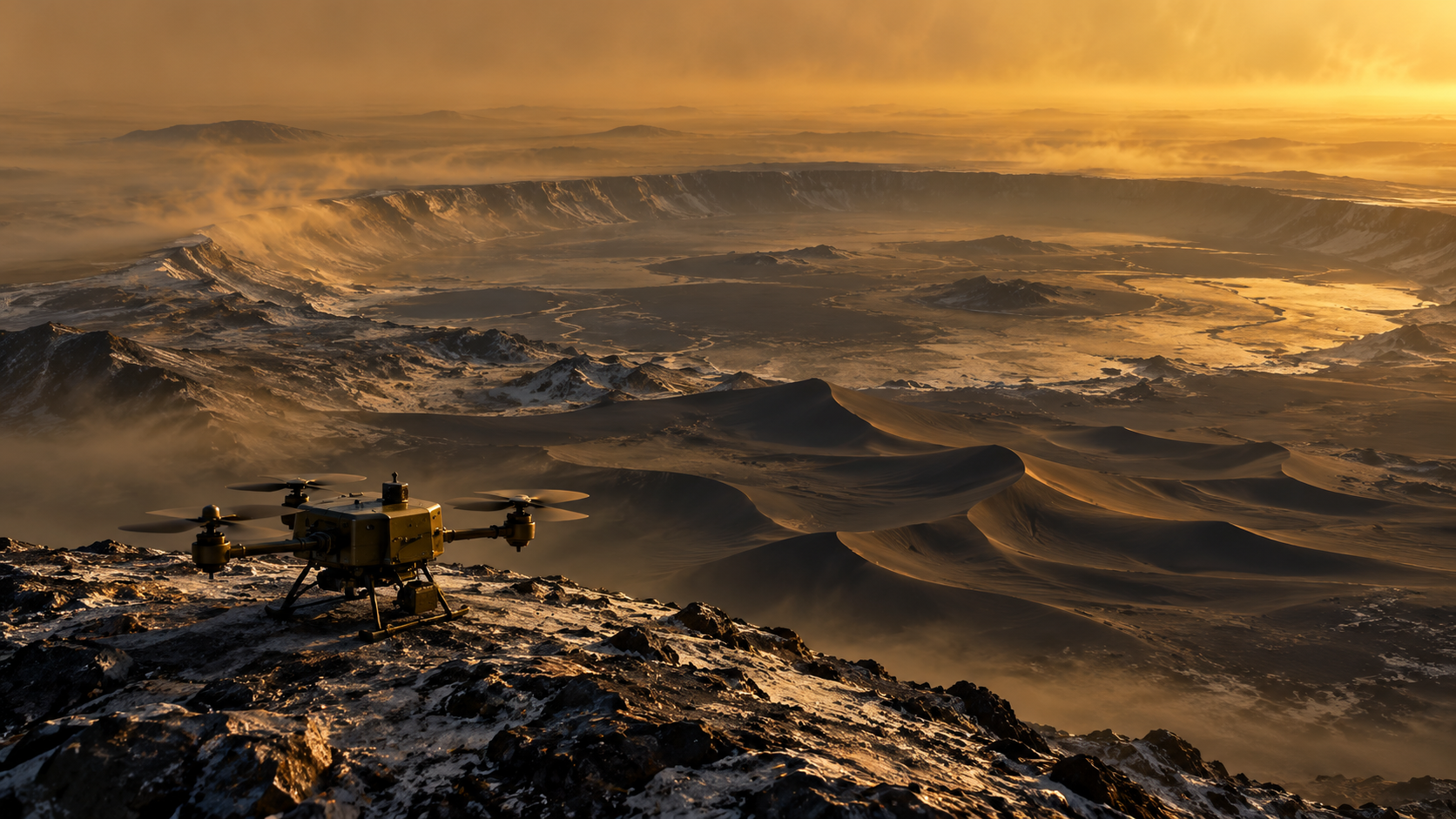
NASA describes Dragonfly as a mission to examine Titan’s chemistry and habitability using a rotorcraft that can explore different locations. That mobility helps explain why a review of candidate sampling environments matters before measurements arrive. [2]
Neither the mission description nor this review reports the discovery of life at Selk. Chemical complexity and biological activity are different conclusions. A future result would need to establish which processes best account for the sample, rather than rely on the fascination of its extraterrestrial address.
The question this review sharpens
For readers following the search for life, the strongest part of this story is its precision. It identifies an environment, a set of possible reactions and a way to decide where evidence might be preserved.
The useful next update will therefore be tied to a measurement or a change in the sampling argument. Until then, Selk is an investigation being prepared, not a solved mystery. The review tells us what scientists hope to learn from the scene, and why the choice of scene could determine the answer.