
Debris is discovered
Ranch foreman W. W. “Mac” Brazel reports unusual material scattered across land northwest of Roswell after a storm. The debris is taken to local authorities and then to Roswell Army Air Field.
One debris field. Two military announcements. Decades of conflicting testimony. This is the paper trail behind the most famous UFO case in American history.
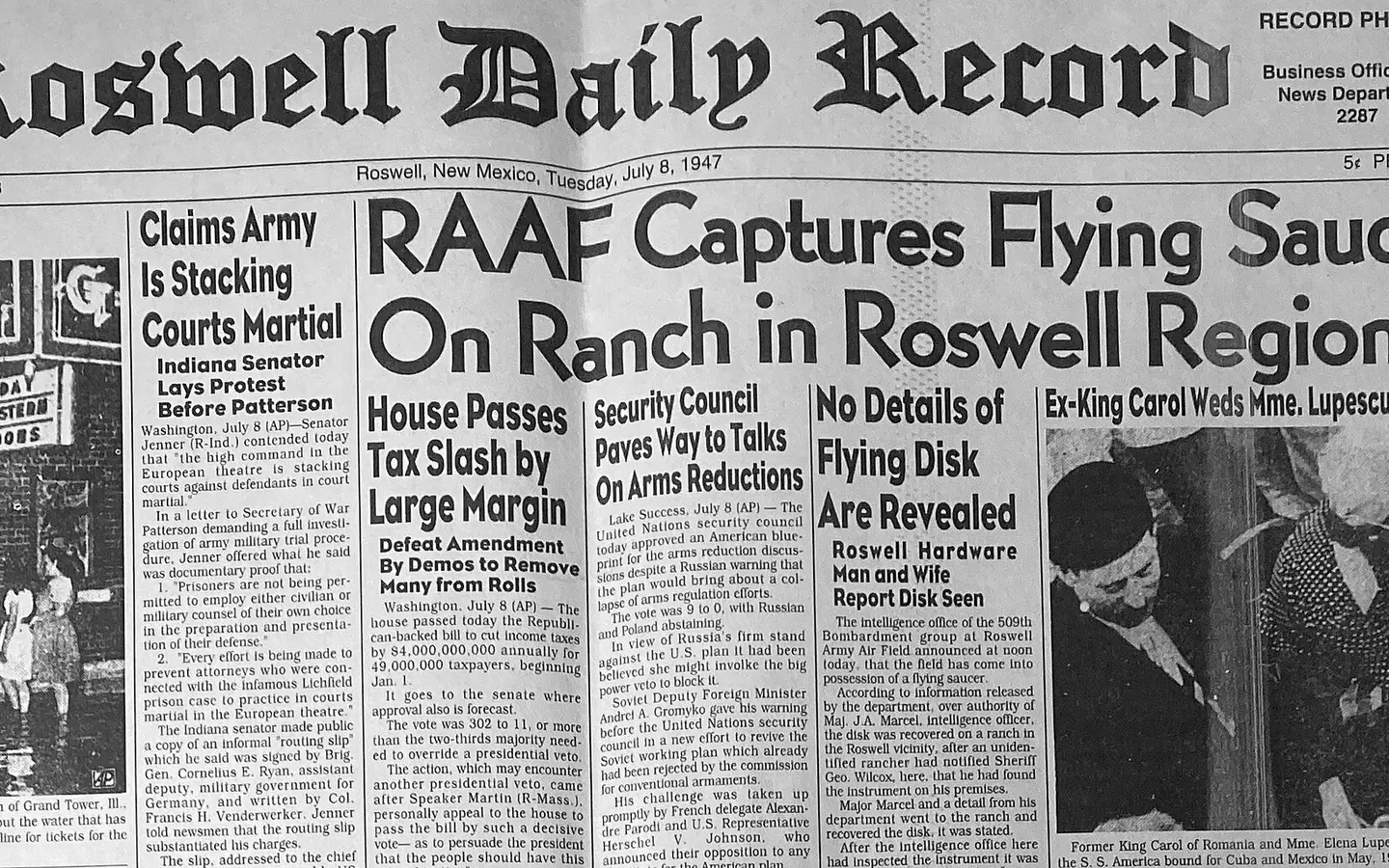
ARCHIVAL FRONT PAGE / ROSWELL DAILY RECORD · JULY 8, 1947
Historical reporting; not physical evidence of an extraterrestrial craft.
Ranch foreman W. W. “Mac” Brazel reports unusual material scattered across land northwest of Roswell after a storm. The debris is taken to local authorities and then to Roswell Army Air Field.
The Roswell Army Air Field issues a press release saying personnel recovered a flying disc. Newspapers spread the announcement across the country within hours.
Military officials display balloon material to reporters and identify the wreckage as a weather balloon. Public attention fades, but the reversal becomes the central mystery of the case.
Official reviews connect the debris to Project Mogul, a classified balloon program intended to detect Soviet nuclear tests. A later report attributes stories of bodies to test dummies and separate military incidents.
The U.S. Air Force identifies the recovered material as part of Project Mogul, whose purpose was classified in 1947. That secrecy offers a practical reason for the military’s vague and contradictory public statements.
The original “flying disc” announcement, later witness accounts, and the long delay before Project Mogul was publicly discussed left room for suspicion. Some testimony emerged decades later and conflicts with other accounts.
Close this file and return to the main archive.
Back to all case files →