
Why this hearing mattered
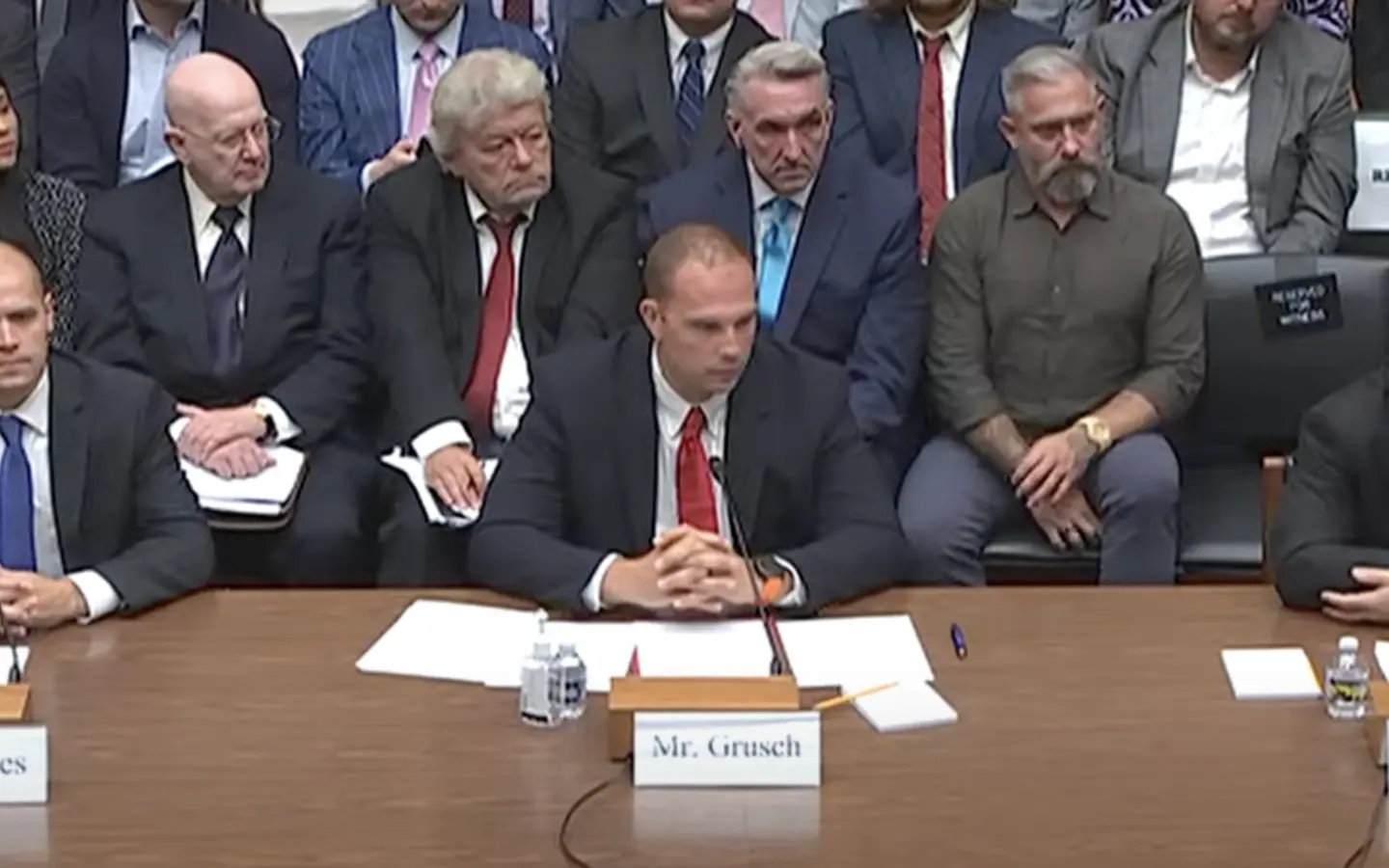
On July 26, 2023, the House Oversight Committee held a public hearing on unidentified anomalous phenomena—UAP, the government’s current term for observations that cannot immediately be identified.
The hearing did not prove that extraterrestrial craft had reached Earth. It did something more limited, but still unusual: it placed military encounters, reporting failures, and extraordinary whistleblower allegations together in a formal public record.
For decades, the UFO subject lived in a strange borderland between folklore and classified aviation. The 2023 hearing showed that Congress was willing to discuss it as an oversight problem: Are pilots able to report unusual objects without stigma? Are agencies sharing information? Is Congress being told enough about highly classified programs?
Testimony under oath is evidence that a witness made a claim. It is not, by itself, proof that every claim is true. Public documents, sensor data, firsthand access, and independent corroboration determine how much weight a claim can carry.
Three witnesses, three different cases
Ryan Graves: the reporting problem
Former Navy pilot Ryan Graves described recurring observations by aviators and argued that unidentified objects in training areas represent a flight-safety concern regardless of their origin. His central case was practical: pilots need a credible way to report what they see without risking their careers or reputations.
David Fravor: the firsthand encounter
Retired Navy Commander David Fravor revisited the November 2004 “Tic Tac” encounter near the USS Nimitz. Fravor said he directly observed a smooth, white object maneuvering over disturbed water before it accelerated away. Other aviators and radar operators have described related observations, but the full sensor record has not been released publicly.
David Grusch: the retrieval allegations
Former intelligence officer David Grusch told lawmakers that he had been informed of a long-running crash-retrieval and reverse-engineering program hidden from Congress. He also used the phrase “non-human biologics” when asked about material allegedly recovered with craft.
Grusch said his knowledge of those alleged programs came from interviews with people he considered to have direct access. He did not present physical material, photographs, program documents, or firsthand observations of a recovered craft during the public hearing. He repeatedly offered to provide sensitive details in a classified setting.
What entered the record—and what did not
A congressional hearing occurred. The three witnesses gave sworn testimony. Fravor described a firsthand encounter. Graves described pilot reporting concerns. Grusch made allegations based largely on information from others.
No recovered vehicle, biological sample, authenticated program document, or complete sensor package was produced at the hearing. The alleged retrieval program was not independently demonstrated in the public session.
The Department of Defense has said that its All-domain Anomaly Resolution Office had not found verifiable information substantiating claims that programs involving extraterrestrial materials existed or had been improperly withheld from Congress. That denial does not explain every military sighting, but it directly contests the broadest interpretation of Grusch’s allegations.
The careful conclusion is narrower than either “aliens confirmed” or “nothing to see.” The hearing documented serious claims and real institutional concerns. It did not publicly resolve the origin of the reported objects or prove a hidden non-human technology program.
How the disclosure story reached 2023
A hidden Pentagon effort becomes public
Reporting reveals a previously little-known Defense Department program that examined military UFO reports, helping move the subject back into mainstream national-security coverage.
The Pentagon releases three Navy videos
The Defense Department formally releases the “FLIR,” “Gimbal,” and “Go Fast” videos and characterizes the objects shown as unidentified.
Intelligence agencies issue a preliminary assessment
A public report reviews 144 military cases and says most lacked enough high-quality data for firm conclusions.
The House hearing puts witnesses under oath
Graves, Grusch, and Fravor testify publicly about pilot safety, a military encounter, and alleged hidden retrieval programs.
NASA publishes its independent UAP study
NASA says there is no conclusive evidence in the reviewed literature that UAP have an extraterrestrial origin and calls for better, more systematic data collection.
What actually changed
The hearing made the subject easier to discuss in official settings, but it did not produce a single disclosure moment. Instead, it sharpened a conflict over access: lawmakers sought more testimony and records, while witnesses and agencies pointed to classification rules, compartmented programs, and legal limits on what could be discussed publicly.
It also clarified that “UAP disclosure” contains several different questions. Some concern aviation safety and sensor interpretation. Others concern government transparency and congressional oversight. The most extraordinary question—whether any government possesses technology of non-human origin—still requires extraordinary, publicly examinable evidence.
That is where this first disclosure file closes: not with a verdict, but with a standard. Keep the testimony. Preserve the documents. Release the data that can be released. Separate firsthand observation from secondhand allegation. Then follow the evidence wherever it leads.