
The archive contains surprise and explanation
An astronaut describing particles outside a spacecraft window is an arresting fragment of audio. It becomes a different story when the mission history and later explanation travel with it. Scott Carpenter’s observations offer an unusually useful example of a genuine surprise that prompted further testing rather than an alien identification.
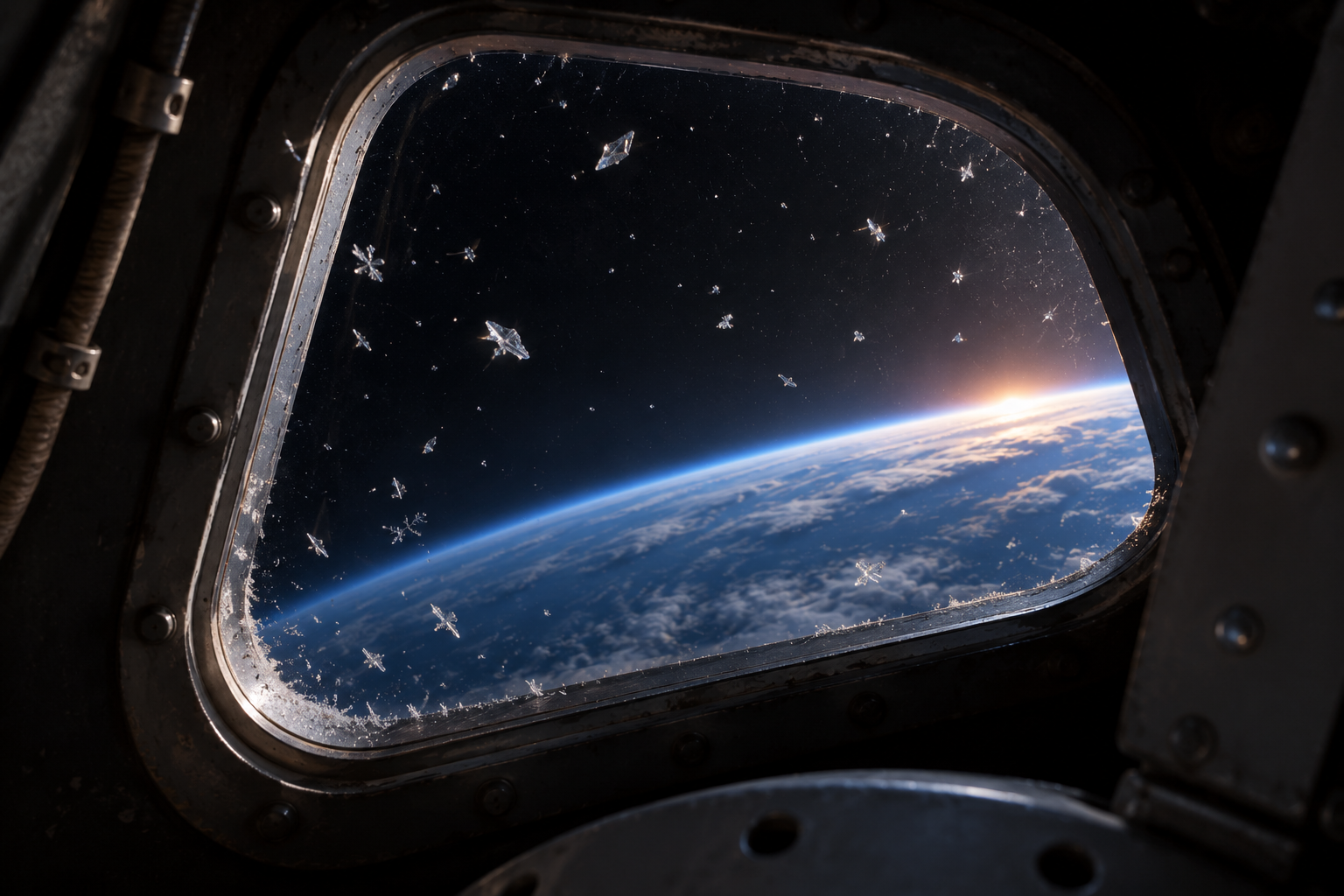
NBC’s May files coverage revisited Carpenter’s Mercury-era particle descriptions. NASA’s history of Aurora 7 supplies the crucial context: during his 24 May 1962 flight, Carpenter saw the particles associated with the earlier firefly reports and described a snowflake-like appearance. The comparison concerned what they looked like, not living creatures. [1][2]
A small physical test changed the interpretation
NASA records that a bump against the capsule hatch sent particles past the window. Further taps produced further showers. Its account connects this behavior with frost on the spacecraft exterior. In a later oral history, Carpenter likewise recalled realizing that illuminated pieces of ice were coming loose when he struck the capsule. [2][3]
Our assessment: this is the part easily lost when archival audio is edited into a compilation of unexplained astronaut encounters. A description made during an unfamiliar experience need not remain the observer’s final interpretation. The sequence of noticing, testing and explaining deserves as much attention as the initial surprise.
Why it belongs beside unresolved cases
Including an explained observation improves an evidence archive by showing what a useful resolution can look like. Here the explanation relates a change in the scene to a repeatable action by the observer. That does not settle unrelated UAP cases; it supplies a standard for evaluating proposed explanations. Carpenter’s particles should therefore appear with their mission context and subsequent account, rather than being promoted as newly released proof that alien objects accompanied a Mercury spacecraft.